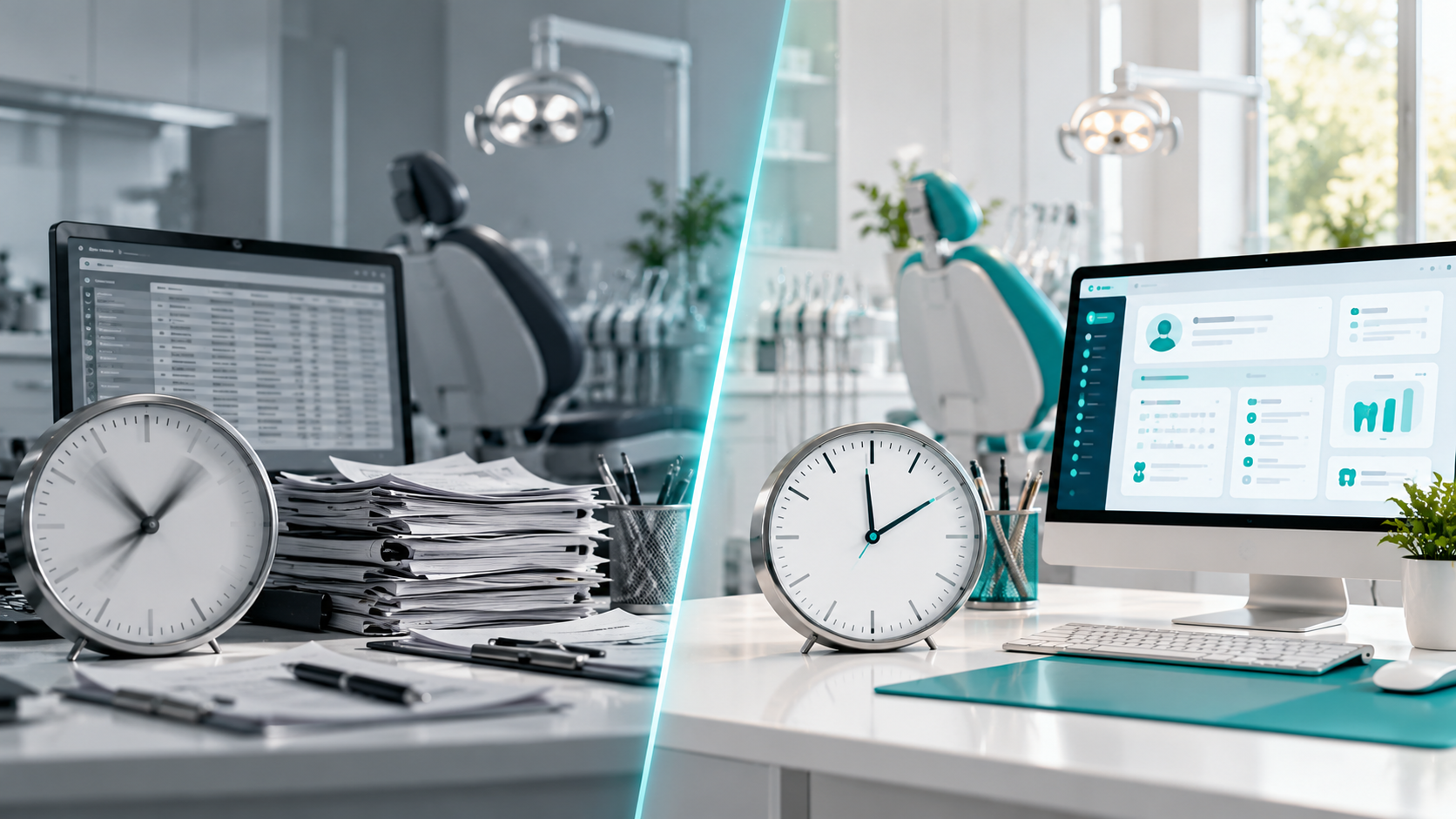
Most dentists know they're busy. What they don't always see is where the time actually goes.
It's easy to point at the obvious bottlenecks - a patient running late, a lab case that didn't arrive, a schedule that's overbooked by 2 PM. But underneath those visible disruptions, there's a quieter layer of time loss that happens every single day, in every operatory, at every practice. These are the hidden time traps - the small inefficiencies that individually seem minor but collectively steal hours from your week.
Here are the five biggest ones, and how AI-powered workflows are eliminating them.
Time Trap #1: End-of-Day Charting
This is the most common and most damaging time trap in dentistry. You see your last patient at 5 PM. You start charting at 5:30. You finish somewhere between 6:30 and 7:00 - if you're being thorough.
Every dentist who charts after hours knows the problem: by the time you sit down to document, the clinical details are already fading. Was it the mesial or the distal of #14? Did the patient say the sensitivity started two weeks ago or two months ago? Did you discuss the implant option or just the bridge?
The result is documentation that's slower (because you're reconstructing instead of recording) and less accurate (because memory degrades with every hour that passes). You're spending more time producing a worse note.
How AI solves it
When you narrate chairside during the exam, the note generates in real time. There's nothing left to chart at the end of the day because documentation happened during the visit - while you were already examining the patient and talking through your findings. The time cost of charting drops from minutes per note to seconds, and after-hours documentation drops to near zero.
Time Trap #2: Toggling Between Systems
Count the number of times you switch applications during a single patient visit. You check the schedule in your PMS. You pull up the patient's chart. You open a separate window for radiographs. You switch to your charting template or text editor. You go back to the PMS to enter procedure codes. You open another tab for insurance eligibility.
Each switch takes only a few seconds, but the cognitive cost is real. Context switching - moving your attention from one system to another - has been shown to reduce productivity by as much as 40%. In a dental practice, it manifests as small errors, repeated lookups, and a persistent feeling that you're working harder than you should be for the output you're getting.
How AI solves it
DentScribe integrates directly with your practice management system - Dentrix, Eaglesoft, or Open Dental. The note you generate chairside publishes straight to the PMS without copy-pasting, reformatting, or re-entering data in a different system. One narration, one output, one destination. The toggling disappears because the documentation lives where it needs to end up.
Time Trap #3: Redundant Data Entry
How many times does the same piece of clinical information get entered in a dental practice? The dentist narrates or types a finding. The assistant enters it into the chart. The front desk translates it into a procedure code for billing. Someone else enters it into a referral letter or a treatment plan printout for the patient.
Each handoff introduces delay, potential for error, and duplicated effort. The information doesn't change - but it gets re-keyed, re-formatted, and re-entered as it moves through the workflow. In a busy practice seeing 25 to 30 patients a day, redundant data entry can consume a cumulative hour or more of staff time daily.
How AI solves it
When the AI generates a structured SOAP note from your narration, the clinical information is captured once and flows downstream. The note populates the PMS. The findings map to the right sections. The treatment plan aligns with the assessment. Instead of multiple people entering the same data in different formats, the single narration becomes the source of truth for the entire record.
End-of-day charting, system toggling, redundant data entry, unstructured huddles, and incomplete notes add up to 2-3 hours of lost productivity per day - time that doesn't show up on any schedule but absolutely shows up in your overhead and stress level.
Time Trap #4: The Morning Huddle Without Data
The morning huddle is supposed to be a 10-minute strategic alignment. In most practices, it turns into a 20-minute scramble through charts, trying to remember what was discussed at the last visit, what treatment was accepted, and what follow-up was planned.
The problem isn't the huddle itself - it's that the information needed for the huddle is scattered across notes, treatment plans, and (too often) someone's memory. Without structured, consistent documentation feeding into the huddle, the team spends more time finding information than acting on it.
How AI solves it
When every visit produces a consistently structured SOAP note with a clear assessment and plan, the morning huddle has something to work with. DentScribe's GPS Morning Huddle takes it further - pulling production data, scheduled procedures, and outstanding treatment plans into a single view so the team can align on the day's priorities in minutes, not in a chart-digging session.
Time Trap #5: Incomplete Notes That Create Downstream Work
This is the time trap that hides best, because the cost shows up days or weeks later.
A note that's missing the clinical rationale for a procedure leads to a denied insurance claim - which means someone has to write a narrative, pull supporting documentation, and resubmit. A note that's vague about the treatment plan leads to confusion at the next visit - which means the dentist spends the first five minutes of the appointment re-examining and re-assessing instead of continuing care.
Incomplete documentation doesn't just create compliance risk. It creates rework - and rework is the most expensive kind of time loss because it duplicates effort that should have been done right the first time.
How AI solves it
AI-powered narration captures everything you say during the exam and structures it into a complete SOAP note - Subjective, Objective, Assessment, and Plan. Because the note builds from your full narration rather than from a template you might skip through or a freeform entry you might cut short, the output is more complete by default. The clinical rationale is documented because you narrated it. The treatment plan is clear because you stated it. The follow-up is captured because you mentioned it.
Adding Up the Hidden Hours
Here's what these time traps look like across a typical day:
End-of-day charting
45-90 minutes spent reconstructing notes from memory after the last patient leaves.
System toggling
20-30 minutes of lost productivity from context switching between PMS, charting, radiographs, and billing.
Redundant data entry
30-60 minutes of staff time re-keying the same clinical information across systems.
Extended morning huddle
10-15 extra minutes digging through charts instead of aligning on the day's priorities.
Downstream rework
15-30 minutes dealing with denied claims, re-assessments, and missing referral context from incomplete notes.
What Recovery Looks Like
Practices that adopt AI-powered documentation typically see the impact in three phases:
Week one: After-hours charting drops significantly. Dentists finish their last note before their last patient leaves.
Month one: The team notices fewer insurance resubmissions and less confusion at follow-up visits. Morning huddles get shorter and more productive.
Quarter one: The cumulative time savings translate into measurable results - more available chair time, lower documentation overhead, and a team that's working at the pace the schedule intended rather than constantly catching up.
The time traps don't disappear because the practice works harder. They disappear because the workflow stops requiring the same information to be entered, transferred, and reconstructed multiple times.
The Bottom Line
The hardest inefficiencies to fix are the ones you've stopped noticing. End-of-day charting feels normal because you've always done it. Toggling between systems feels inevitable because that's how the software works. Redundant data entry feels like just part of running a practice.
But none of these are requirements of good dentistry. They're artifacts of workflows that were designed before AI could capture, structure, and route clinical information in real time.
The time is there. It's just trapped in processes that no longer need to exist.
Recover the Hidden Hours in Your Workflow
See how AI-powered documentation eliminates after-hours charting, redundant data entry, and the daily time traps slowing your practice down.