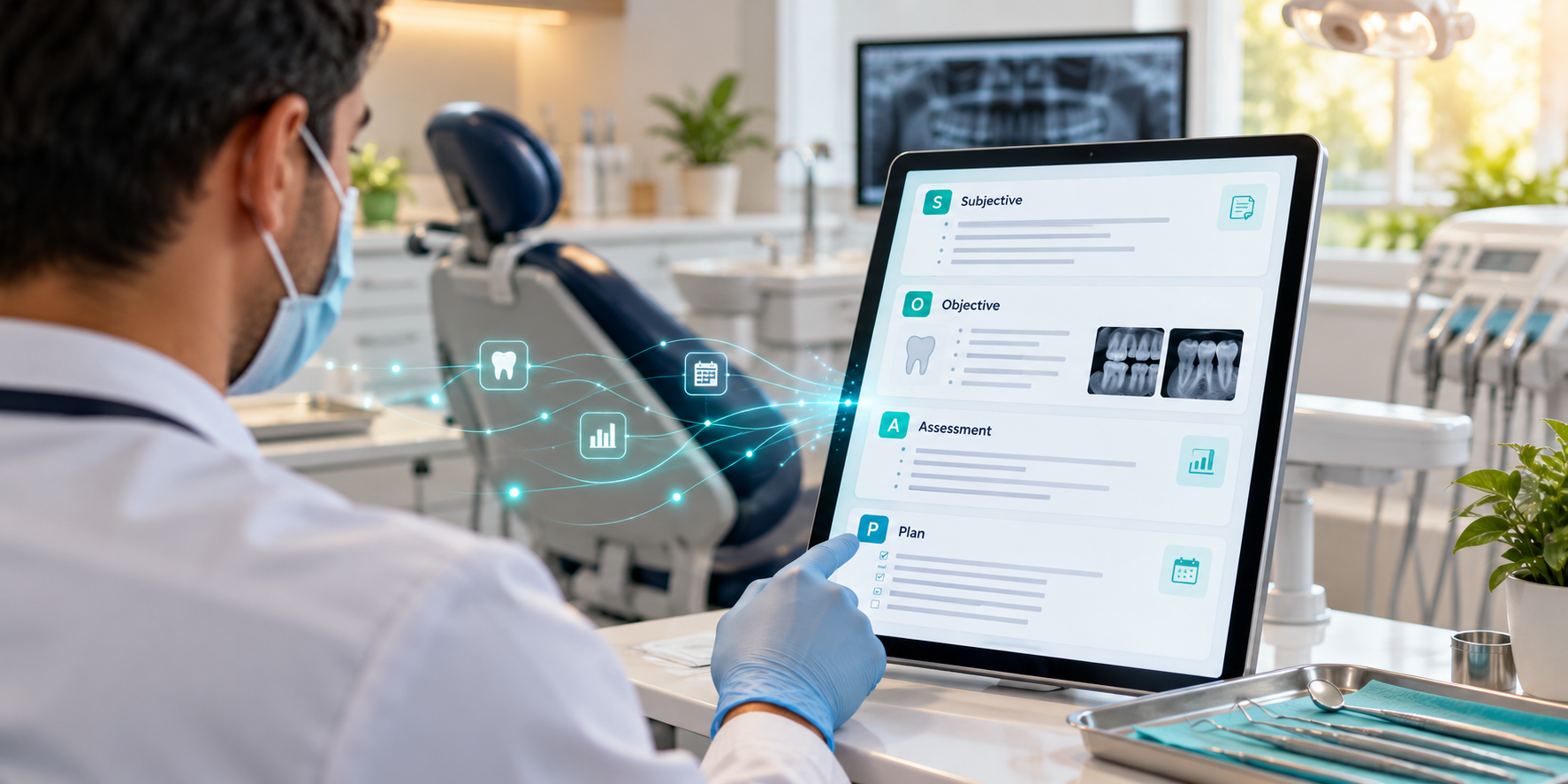
Let's be honest - charting isn't why you went to dental school. But somewhere between the morning huddle and your last patient, documentation became half the job. And now that AI promises to take it off your plate, a fair question follows: can you really trust AI to get it right, and can you still maintain control?
The short answer is yes - but only if the system is built for clinical accuracy from the start, not bolted on as an afterthought. Here's how to make sure your AI-generated SOAP notes are accurate, complete, and still unmistakably yours.
Why Accuracy in AI-Generated SOAP Notes Matters
A SOAP note isn't just a record of what happened. It's a legal document, an insurance justification, and often the only continuity thread between visits. One missed finding, one vague assessment, and you're looking at a denied claim, a compliance flag, or worse - a gap in patient care.
That's why "close enough" doesn't work in clinical documentation. When AI enters the picture, accuracy isn't optional - it's the whole point.
The Problem With Generic AI Transcription
Most general-purpose transcription tools weren't designed for dentistry. They struggle with terminology like "MOD composite," "Class II furcation," or "periapical radiolucency." The result? Notes that need so much editing, you might as well have typed them yourself.
Common issues with generic AI documentation include:
- Misinterpreting dental-specific terminology and abbreviations
- Confusing tooth numbers or mixing up quadrants
- Losing the clinical context - documenting what was said without capturing what it means
- Producing notes that sound clinical but miss key diagnostic findings
- Failing to structure output into proper Subjective, Objective, Assessment, and Plan sections
If you've tried a general AI scribe and walked away frustrated, this is probably why.
How DentScribe Approaches Accuracy Differently
DentScribe wasn't built as a transcription tool that happens to work in dental. It was built for chairside narration - the way dentists actually talk during an exam.
Here's what that means in practice:
1. It Understands Dental Vernacular
DentScribe's AI engine is trained on clinical dental language. It knows the difference between "mesial" and "medial," understands when you say "endo eval needed on 19," and recognizes the clinical significance behind everyday chairside shorthand. You don't have to slow down, spell things out, or speak in templates.
2. Notes Are Structured, Not Just Transcribed
There's a critical difference between transcribing what a dentist says and generating a structured SOAP note. DentScribe doesn't just capture your words - it organizes them into the correct sections: Chief Complaint, Hard Tissue Exam, Soft Tissue Findings, Assessment, Treatment Plan, and Patient Education. Each section follows the clinical logic of the visit, not just the chronological order of the conversation.
3. Real-Time Generation, Not After-the-Fact Summaries
DentScribe generates notes in real time as you narrate during the exam. This matters because context is freshest while you're chairside. You're not reconstructing the visit from memory at 8 PM - the note builds as you work, capturing findings while they're clinically relevant.
4. Direct PMS Integration
Once a note is ready, it publishes directly to your practice management system - Dentrix, Eaglesoft, or Open Dental. No copy-paste, no re-keying, no toggling between apps. This eliminates a common source of transcription errors: the manual transfer step where details get lost, truncated, or placed in the wrong field.
In a multi-provider general practice on Dentrix, DentScribe reduced charting time by 1.6 hours per day, improved note completeness by 38%, increased follow-up capture by 24%, and brought after-hours documentation to near zero.
Staying in Control: The Clinician's Role
Here's where some dentists hesitate. If AI writes the note, does the dentist lose control? Not if the system is designed correctly. AI should assist documentation, not replace clinical judgment.
Review Before Finalizing
The most important habit with any AI documentation tool is reviewing the note before it goes to the PMS. DentScribe generates the note in real time, which means you can glance at it chairside and catch anything that needs adjustment - a tooth number, an additional finding, or a nuance the AI captured differently than you intended.
Think of it as the difference between dictating to a skilled dental assistant and dictating into a void. The assistant gives you something structured to review, not a blank page to fill.
Edit With Precision
When a note needs adjustment, you're editing - not rewriting. That's a fundamental shift. Instead of spending 3 to 5 minutes per note from scratch, you're spending 15 to 30 seconds confirming and tweaking what's already clinically accurate. Over a full day of 20 patients, that difference adds up to more than an hour.
Your Voice, Your Clinical Judgment
AI handles the documentation mechanics - structuring the note, mapping findings to sections, formatting for the PMS. But the clinical thinking is yours. You decide what to narrate, which findings to emphasize, what the assessment is, and what the plan should be. DentScribe captures your clinical judgment; it doesn't substitute its own.
Five Practical Tips for Maximizing AI Accuracy
Whether you're just starting with AI documentation or looking to get more out of it, these habits make a measurable difference:
Narrate clearly and completely
AI accuracy starts with the input. State the tooth number, the surface, the finding, and the planned procedure. "MOD composite on 14, replacing fractured amalgam" gives the AI everything it needs. "We'll fix that one" doesn't.
Use your normal clinical language
DentScribe is built for how dentists actually talk - you don't need to speak in formal templates or slow down for the technology. Say "perio pocket 5mm on the ML of 3" the way you'd say it to your assistant.
Review notes the same day
Build a 2-minute end-of-day review into your routine. Check that findings, tooth numbers, and the treatment plan match your clinical intent. Catching a small error today prevents a larger problem at the claim or audit stage.
Narrate the "why," not just the "what"
Good SOAP notes tell the clinical story. Instead of just listing findings, narrate the reasoning: "Recurrent decay under existing crown on 30 - recommend crown replacement with buildup." The assessment and plan write themselves when the narration includes clinical rationale.
Trust but verify during the first two weeks
When you first adopt AI documentation, spend a few extra minutes reviewing every note carefully. Most dentists find that within one to two weeks, the AI's output aligns closely with their clinical voice, and review time drops significantly.
What Accuracy Looks Like in Practice
Here's a practical example. During a routine exam, you narrate:
"Patient presents for a periodic exam. Chief complaint is sensitivity on the upper right. Hard tissue exam - recurrent decay on the mesial of number 3 under existing PFM crown. Recommend crown replacement with core buildup. Soft tissue within normal limits. Perio stable, recall in six months. Discussed treatment options and costs with patient. Patient wants to proceed, scheduling for next week."
DentScribe takes that narration and generates a structured SOAP note with the chief complaint isolated, findings organized under the correct exam sections, a clear assessment of recurrent decay on #3, and a plan that includes the crown replacement, the patient's acceptance, and the follow-up interval.
You glance at it, confirm it matches your clinical intent, and it posts to the PMS. The entire documentation step took seconds, not minutes.
The Bottom Line
AI accuracy in SOAP notes isn't about replacing your clinical judgment - it's about removing the documentation burden so your judgment can focus where it matters: on the patient in front of you.
The key is choosing a system built for dental from the ground up, one that understands your language, structures notes the way you need them, and integrates directly with how your practice already works. And then staying engaged - reviewing, adjusting, and letting the AI learn the rhythm of your clinical voice.
That's not losing control. That's getting your time back.
See AI-Generated SOAP Notes in Action
View real notes generated from everyday clinical scenarios - no edits, no fluff - or book a demo to see DentScribe in your workflow.